
Endocannabinoid System and Cancer

By Martin Helcman, Pharmacist
This article first appeared in Konopí magazine on January 12, 2026
https://magazin-konopi.cz/endokanabinoidni-soustava-a-rakovina/
Shared with permission from Lukas Hurt
Although cancer is often classified as a so-called civilization disease, it is not an "invention" of modern times – the first evidence of its existence was discovered in dinosaur fossils [1]. Despite this, today's medical science still does not know a reliable treatment for virtually any type of cancer. However, Cannabis healers, referring to a number of their patients, claim that a quality Cannabis extract can help treat and sometimes even cure cancer. How is it really? Is there scientific evidence to support such claims?
The term "cancer" refers to a whole group of diseases – there are more than 100 known types of malignant tumors, and even within one type, there are large individual differences between specific patients.
Currently, cancer is the second non-communicable disease [2] that causes death in humans. In the first place is ischemic heart disease, i.e., insufficient blood supply to the heart muscle, most often due to clogging of the arteries with cholesterol. There is growing evidence that both of these diseases are largely caused by the malfunctioning of the endocannabinoid system.
What Is Necrosis and Apoptosis?
In order to be able to outline in very rough outlines how the endocannabinoid system is related to the formation (and death) of tumors, we must first introduce the terms necrosis and apoptosis. Every cell in the body has a limited lifespan, and there are basically two ways in which it can end. In the first case, in necrosis, the cell membrane is damaged and the contents of the cell spill into the environment.
When the endocannabinoid system is functioning properly, it always regulates apoptosis towards an optimal state.
Since it is toxic to the surrounding tissue, other cells also die and inflammation occurs. Necrosis can be caused, for example, by physical factors (heat, pressure, radiation, etc.), infections or chemical damage. In the second case, in apoptosis, also known as programmed cell death, the cell breaks down into smaller parts that are absorbed by specialized white blood cells (phagocytes).
This usually occurs when the cell is old, but also due to mild forms of the damage mentioned above. It is the disorder of apoptosis that leads to the fact that the damaged cell continues to live and reproduce. And this is how a tumor cell is formed [3].
Induction of Apoptosis
The endocannabinoid system, especially its CB1 and CB2 receptors, plays a key role in the regulation of apoptosis. It can both promote and prevent apoptosis, but importantly – when the endocannabinoid system is functioning properly, it always regulates apoptosis towards an optimal state.
For example, it reduces [4] it in neurodegenerative diseases, when this process is triggered even in healthy neurons, which leads to the development of some symptoms in diseases such as multiple sclerosis. In cancer cells, on the other hand, the endocannabinoid system increases apoptosis, most often through the activation of enzymes that begin to form highly reactive oxygen particles, also known as "free radicals" in the cells. These then trigger a cascade of processes that lead to apoptosis.
The endocannabinoid anandamide [5] has also been shown to increase apoptosis in tumor cells through other receptors closely related to the endocannabinoid system – such as GPR55, TRPV1 or PPARγ.
An effective and safe anticancer drug or therapeutic procedure should always cause apoptosis, not necrosis. As mentioned above, necrosis releases toxic content into the surrounding tissue. This causes severe inflammation, which in the case of sudden death of a large part of the tumor can be the cause of serious damage to the body, which can even end in death.
Slowing Down of Pathological Growth
However, inducing apoptosis is not the only way the endocannabinoid system can prevent tumor growth. Since cancer cells have a significantly higher metabolism than normal cells, they also need a greater supply of oxygen and nutrients. As a result, tumors are usually much more densely interwoven with blood vessels than ordinary organs. However, this pathological "network" must first grow in tumors. One of the main molecules that signals tissue to form new blood vessels is VEGF (vascular endothelial growth factor).
If Cannabis or substances derived from it are used as an adjunct to standard chemotherapy, the risk of interactions should not be underestimated.
This protein is crucial for the growth of the blood system not only in tumors, but also in embryos or muscles after exercise. Activation of CB1 and CB2 receptors in tumor tissue causes a decrease in the production of this signal. The same effect was observed with two major endocannabinoids: anandamide and 2-AG [6]. In other words, the activity of the endocannabinoid system leads to a slowdown in the pathological growth of new blood vessels, and thus the tumor itself.
Slowing Down Partitioning
Another fundamental difference between cancer cells and healthy cells is their ability to divide unlimitedly. This is related to the disruption of cell cycle regulation, or control of when a cell should start dividing and when it should stop. This is primarily controlled by kinases, molecules that, when activated, allow the cell to enter the next stage of division. The way these controllers work is extremely complex. But there is growing evidence that they are largely controlled by the endocannabinoid system.
It is therefore not surprising that, according to several studies, activation of CB1 and CB2 receptors leads to a slowdown or even a stop in the division of tumor cells, but not healthy cells. Similar to apoptosis, the activity of the endocannabinoid system is directed towards achieving an optimal state. In the case of the endocannabinoid 2-AG, the ability to stop division has been observed specifically in laboratory cultures of prostate cancer cells.
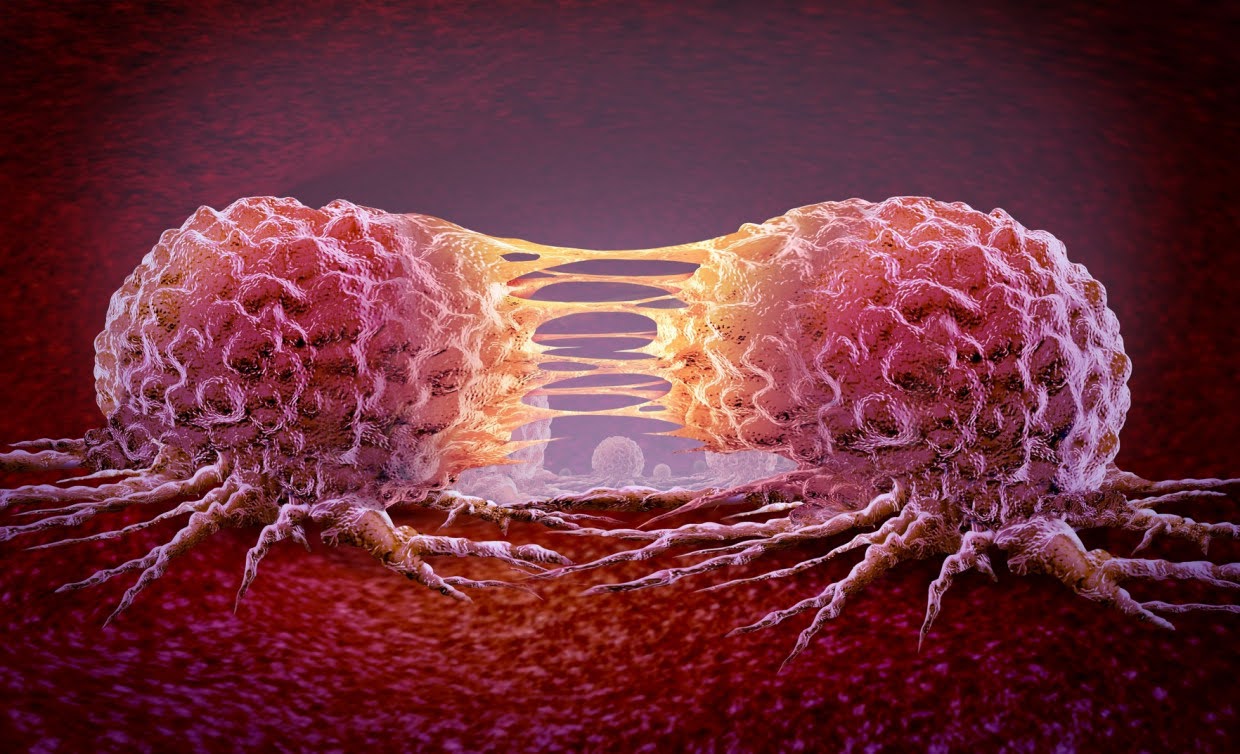
Metastasis of tumor cells. Source: Shutterstock
Among the most important of these are metalloproteinases (MMPs). WIN55,212-2 [7], which is a synthetic cannabinoid that can activate CB1 receptors and, to a lesser extent,CB2, has been found to reduce levels of these enzymes. Specifically, MMP2 and MMP9, and thus suppresses the ability of tumor cells to penetrate new tissue.
And what about suppositories?
There is probably no more controversial form of Cannabis extract administration than rectal and vaginal suppositories. According to several studies, cannabinoids are not absorbed from the lining of the colon and therefore cannot enter the bloodstream. However, there is a lot of anecdotal evidence about their effectiveness and positive experiences of patients with different diagnoses.
One possible but not yet confirmed explanation could be a significant concentration of CB1 and CB2 receptors in the rectal part of the intestine. Through them, Cannabis suppositories could affect not only local inflammation of the mucous membrane but also the overall function of the immune system. And thus tumor processes. However, the rectum is crisscrossed not only by blood but also by lymphatic vessels, and it is highly likely that cannabinoids will be absorbed into them. Fat-rich lymph is a more suitable environment than blood for the solubility of cannabinoids.
References
1. Chandrasinghe PC, Cereser B, Bertazzo S, Csiki-Sava Z, Stebbing J. Preserving Fossilized Soft Tissues: Advancing Proteomics and Unveiling the Evolutionary History of Cancer in Dinosaurs. Biology. 2025; 14(4):370. https://doi.org/10.3390/biology14040370
2. “Noncommunicable Diseases.” World Health Organization, World Health Organization, www.who.int/news-room/fact-sheets/detail/noncommunicable-diseases. Accessed 2 Feb. 2026.
3. Pistritto, Giuseppa et al. “Apoptosis as anticancer mechanism: function and dysfunction of its modulators and targeted therapeutic strategies.” Aging vol. 8,4 (2016): 603-19. doi:10.18632/aging.100934
4. Jia, Ji, Ma, Lei, Wu, Mingchun, Zhang, Lei, Zhang, Xiajing, Zhai, Qian, Jiang, Tao, Wang, Qiang, Xiong, Lize, Anandamide Protects HT22 Cells Exposed to Hydrogen Peroxide by Inhibiting CB1 Receptor-Mediated Type 2 NADPH Oxidase, Oxidative Medicine and Cellular Longevity, 2014, 893516, 16 pages, 2014. https://doi.org/10.1155/2014/893516
5. Anandamide Induces Apoptosis in Human Cells via Vanilloid Receptors Maccarrone, Mauro et al. Journal of Biological Chemistry, Volume 275, Issue 41, 31938 - 31945
6. Kasem Nithipatikom, Marilyn A. Isbell, Michael P. Endsley, Jeffrey E. Woodliff, William B. Campbell, Anti-proliferative effect of a putative endocannabinoid, 2-arachidonylglyceryl ether in prostate arcinoma cells, Prostaglandins & Other Lipid Mediators, Volume 94, Issues 1–2, 2011, Pages 34-43, ISSN 1098-8823, https://doi.org/10.1016/j.prostaglandins.2010.12.002.
7. Notaro A, Emanuele S, Geraci F, D’Anneo A, Lauricella M, Calvaruso G, Giuliano M. WIN55,212-2-Induced Expression of Mir-29b1 Favours the Suppression of Osteosarcoma Cell Migration in a SPARC-Independent Manner. International Journal of Molecular Sciences. 2019; 20(20):5235. https://doi.org/10.3390/ijms20205235
About Martin Helcman
Martin Helcman is a Slovak pharmacist who studied and works in Brno. In 2020, he defended his rigorous thesis on the constituent substances of Cannabis. He works as a pharmacist and educator who is always happy to share his wealth of knowledge.
Click the Learn More Button