
Cannabis, Menopause, Andropause, and Hormones
By Angel Johansen - Certified Medical Cannabis Educator
Evidence, Uncertainty, and Clinical Perspective
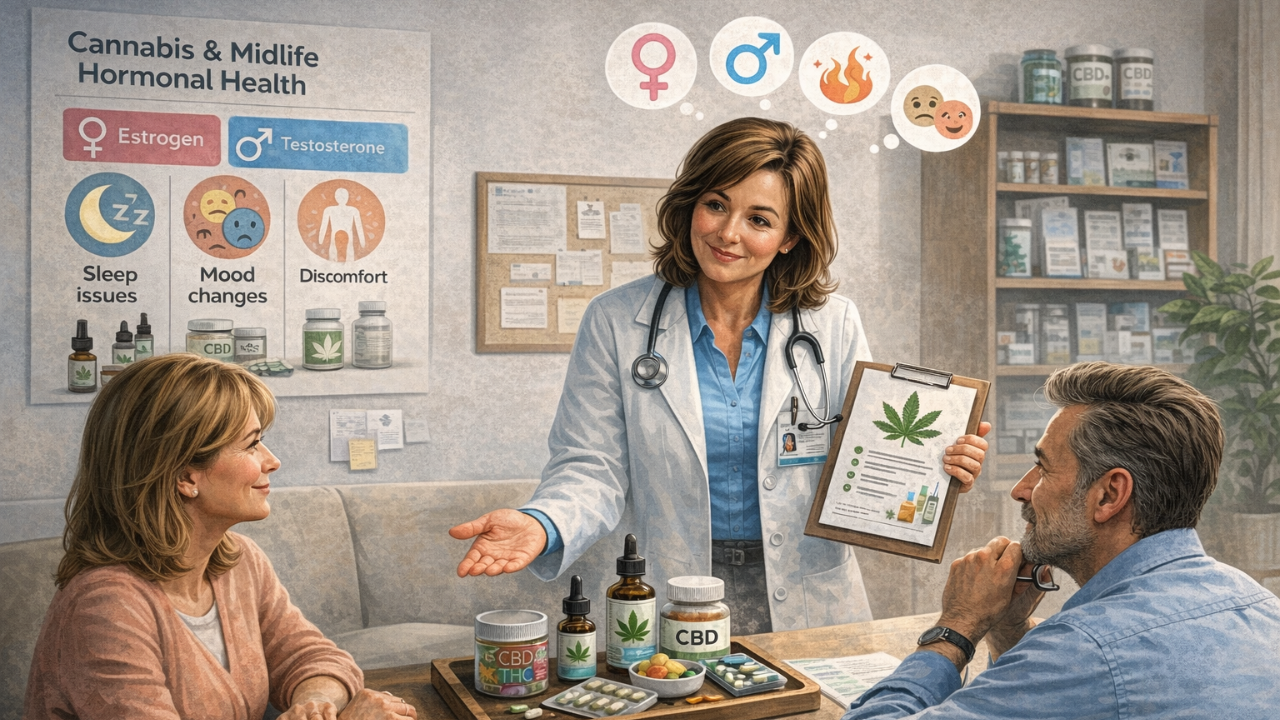
Menopause and the gradual decline in testosterone that comes with aging can change how people sleep, regulate body temperature, think, move, and experience intimacy. For some, the shift is manageable. For others, it can be disruptive enough to affect work, relationships, and overall quality of life.
As Cannabis becomes more available in many places, more midlife adults are considering whether it might help with these changes, especially when standard treatments do not work well or cause side effects. [1] [2]
It is also important to note that clinical evidence is still limited. Most information comes from observational studies and patient surveys, not randomized controlled trials (RCT). [1] [2] [3] Since most of the current evidence comes from observational studies and self-reports, conclusions about how effective these methods are are still tentative and should be viewed with caution.
Cannabis and Menopausal Symptoms
Surveys suggest that those in the menopausal transition often turn to Cannabis to help with sleep problems, anxiety, irritability, and mood changes.¹ Some also say it improves their overall quality of life. [2]
The reality is that we are still in the early stages of this. Meaningful, large-scale trials on Cannabis and menopause are not abundant, and that absence is felt — especially by women who are already living the experience. Sleep that finally comes easier. A mood that stops swinging so hard. Physical discomfort that backs off enough to make daily life feel manageable again. These are not small things, and they deserve more than a dismissive shrug from the medical community.
What we cannot yet say with any real confidence is how reliably those benefits show up, or what specific circumstances make them more or less likely. That part is still being worked out.
Menopause Patterns of Use and Symptom Focus
Most surveys about menopause show that women and individuals experiencing menopause often use inhaled Cannabis products and edibles. [1]
While many healthcare providers recommend non-inhaled forms like tinctures or capsules to avoid lung exposure and allow for more consistent dosing, most are not extensively trained in Cannabis therapeutics.
Working with a Cannabis educator, coach, or knowledgeable healthcare provider can help determine the best consumption method and dosing approach for individual needs.
Midlife users most frequently report targeting:
Difficulty falling or staying asleep [1] [2]
Anxiety, mood variability, or irritability [1] [2]
Chronic musculoskeletal or pelvic discomfort [1] [2]
Sexual discomfort or reduced desire, often in the context of sleep or pain disruption [2] [3]
The amount used is important. Since heart and metabolic risks increase with age, it is especially important for midlife adults to increase doses slowly and carefully.[4]
Andropause, Testosterone, and Male Reproductive Health
Age-related declines in testosterone within some men and individuals can lead to tiredness, lower sex drive, changes in erections, and shifts in body shape.
Studies on Cannabis and testosterone show mixed results. Earlier U.S. studies did not find a clear drop in testosterone among men who used Cannabis, and results sometimes depended on how recently they used it.[5] Newer large studies also show varied findings, with no consistent drop across all groups.[6]
Research is more consistent when looking at reproductive health. Reviews and newer studies link heavy or long-term Cannabis use to changes in semen quality, though results still differ between studies.[7] [8]
Clinical Considerations and Individual Risk Factors
Cannabis doesn't work the same for everyone, and some health situations complicate things.
Mental health is important to consider. Products with high THC can make symptoms worse for people with bipolar disorder, psychosis, or severe anxiety.[4] Products with less THC or mostly CBD usually cause fewer problems, but everyone responds differently.
Medications are another thing to think about. CBD changes how the liver breaks down certain chemicals, which also help process many prescription drugs.[9] Because of this, blood thinners, sedatives, medicines that lower the immune system, and some seizure medications can build up or drop in the body when CBD is used. People taking these medicines should expect their doctor to check drug levels and adjust doses if needed.
Individuals with a history of substance use disorder should exercise heightened caution. More frequent check-ins or additional support may be advisable.
Cannabis is not necessarily off the table, but any decision to use it should be made deliberately, with professional guidance whenever possible, and never at the expense of one’s safety or recovery stability.
Cannabis in the Broader Context of Midlife Care
Cannabis should be seen as just one part of a complete care plan. For those who need direct estrogen support, hormone therapy remains a well-established option for hot flashes and vasomotor symptoms.[10] Nonhormonal approaches — including breathwork, movement practices, and cooling strategies — also have a growing body of evidence supporting their effectiveness for symptom relief.[11]
For those who choose to incorporate Cannabis, practical considerations include:
Defining specific symptom goals
Monitoring response over time
Paying attention to dose and THC exposure
Maintaining open communication with healthcare providers where and whenever possible.
Clinical trial interest is increasing, and menopause-focused cannabinoid studies are now appearing in registries.[10] Published outcome data, however, remain limited.
Personal Perspective
I want to close with something personal.
I am a woman in postmenopause, and I use Cannabis in various forms: flower, tincture, and edibles.
For me, it has made a real difference — falling asleep faster, quieting the mental noise at night, keeping my mood steady, feeling more present during intimacy, and staying focused during the day.
I also live with a heart rhythm condition and am not currently on medication for it. So far, I have not noticed any concerning effects on my heart, but my experience is my own and not intended as advice for others.
What I keep coming back to is this — personal experience, shared honestly, has a way of opening doors that clinical language sometimes keeps closed. As the science develops, I hope those conversations keep growing.
References
1. Dahlgren, M. Kathryn PhD1,2,3; El-Abboud, Celine BA1,2; Lambros, Ashley M. BS1,2; Sagar, Kelly A. PhD1,2,3; Smith, Rosemary T. BS1,2; Gruber, Staci A. PhD1,2,3. A survey of medical cannabis use during perimenopause and postmenopause. Menopause 29(9):p 1028-1036, September 2022. | DOI: 10.1097/GME.0000000000002018.
2. Babyn K, Ross S, Makowsky M, et alCannabis use for menopause in women aged 35 and over: a cross-sectional survey on usage patterns and perceptions in Alberta, CanadaBMJ Open 2023;13:e069197. doi: 10.1136/bmjopen-2022-069197
3. Mejia-Gomez, J., Phung, N., Philippopoulos, E., Murphy, K. E., & Wolfman, W. (2021). The impact of cannabis use on vasomotor symptoms, mood, insomnia and sexuality in perimenopausal and postmenopausal women: a systematic review. Climacteric, 24(6), 572–576. https://doi.org/10.1080/13697137.2021.1898581
4. Hoch E, Volkow ND, Friemel CM, Lorenzetti V, Freeman TP, Hall W. Cannabis, cannabinoids and health: a review of evidence on risks and medical benefits. Eur Arch Psychiatry Clin Neurosci. 2025;275(2):281-292. doi:10.1007/s00406-024-01880-2
5. Thistle, J.E., Graubard, B.I., Braunlin, M., Vesper, H., Trabert, B., Cook, M.B. and McGlynn, K.A. (2017), Marijuana use and serum testosterone concentrations among U.S. males. Andrology, 5: 732-738. https://doi.org/10.1111/andr.12358
6. Barbonetti A, Rastrelli G, Sparano C, et al. Is marijuana a foe of male sexuality? Data from a large cohort of men with sexual dysfunction. Andrology. 2024; 12: 9–19. https://doi.org/10.1111/andr.13382
7. Was {10] Payne, Kelly S., et al. “Cannabis and Male Fertility: A Systematic Review.” Journal of Urology, 1 Oct. 2019, www.auajournals.org/doi/10.1097/JU.0000000000000248.
Innes KE, Selfe TK, Vishnu A. Mind-body therapies for menopausal symptoms: a systematic review. Maturitas. 2010;66(2):135-149. doi:10.1016/j.maturitas.2010.01.016
8. Was [11] Amor, Houda et al. “Effects of marijuana and tobacco on male fertility and their relationship to genetic variation of mitochondrial cytochrome C oxidase genes.”Scientific reportsvol. 15,1 7547. 4 Mar. 2025, doi:10.1038/s41598-025-91894-0
9. Was [14] Nachnani R, Knehans A, Neighbors JD, Kocis PT, Lee T, Tegeler K, Trite T, Raup-Konsavage WM and Vrana KE (2024) Systematic review of drug-drug interactions of delta-9-tetrahydrocannabinol, cannabidiol, and Cannabis. Front. Pharmacol. 15:1282831. doi: 10.3389/fphar.2024.1282831
10. Was [13] Faubion, Stephanie S. MD, MBA, FACP, NCMP; Crandall, Carolyn J. MD, MS, MACP, NCMP, FASBMR; Davis, Lori DNP, FNP-C, NCMP; El Khoudary, Samar R. PhD, MPH, FAHA; Hodis, Howard N. MD; Lobo, Roger A. MD; Maki, Pauline M. PhD; Manson, JoAnn E. MD, DrPH, MACP, NCMP; Pinkerton, JoAnn V. MD, FACOG, NCMP; Santoro, Nanette F. MD; Shifren, Jan L. MD, NCMP; Shufelt, Chrisandra L. MD, MS, FACP, NCMP; Thurston, Rebecca C. PhD, FABMR, FAPS; Wolfman, Wendy MD, FRCSC, FACOG. The 2022 hormone therapy position statement of The North American Menopause Society. Menopause 29(7):p 767-794, July 2022. | DOI: 10.1097/GME.0000000000002028
11. Amor, Houda et al. “Effects of marijuana and tobacco on male fertility and their relationship to genetic variation of mitochondrial cytochrome C oxidase genes.”Scientific reportsvol. 15,1 7547. 4 Mar. 2025, doi:10.1038/s41598-025-91894-0
About Angel Johansen:
Angel Johansen, a compassionate Cannabis educator, specializes in empowering women on their journey toward intimacy and embracing the wisdom that accompanies age. With a passion for creating safe spaces and fostering a sense of community, Angel guides women through the nuanced landscape of Cannabis, offering knowledge, support, and a deep understanding of their unique experiences. Her mission is to lead women into their wise years with grace, ensuring they navigate the realms of intimacy and Cannabis with confidence, informed choices, and a profound sense of connection.
Click the Learn More Button